Overview
Over the past decade, deliveries have become embedded in daily routines, and the spaces where items arrive have taken on greater significance. Recent survey data confirms this.
Four out of five people are paying more attention to their mail because they are always on the lookout for their packages, triggered by the rise in e-commerce.1
In an increasingly AI-saturated digital environment, this shift carries new significance because consumer attention is becoming both harder to earn and more valuable.
This report examines how delivery anticipation is influencing behavior, building habits, and raising baseline attention at the doorstep and mailbox.
Executive Summary
As home delivery continues to grow, habit-driven shifts in behavior are redefining the doorstep and mailbox as focal points of consumer attention.
4 out of 5 say they are paying closer attention to their mail because they are on the lookout for packages and deliveries.1
This behavior is driven by the rapid growth of e-commerce, which has transformed how consumers engage with items at the home’s delivery points. What was once an occasional package delivery has now become a daily routine.
In response, consumers track deliveries through apps and real-time notifications, monitoring delivery windows and package arrivals throughout the day. Survey data suggests that e-commerce is not only changing purchasing patterns, but also reshaping how attention is allocated within the home.
This report examines the behavioral mechanisms underlying this change. One key mechanism is anticipation-based monitoring. As consumers become accustomed to expecting package deliveries, they become more vigilant at the point of arrival, leading to more frequent checking and heightened attention to items in that space.
“The home’s delivery space, conditioned by years of package anticipation, tends to be approached with a kind of dopamine-driven readiness …”
— Psychologist and public health scholar Dr. George S. Everly, Jr.
Behavioral research shows that anticipation reinforces conditioned habits. As delivery volume increases, these behaviors become embedded in daily routines. Consumers now check their doorstep and mailbox as part of a recurring pattern, one that is likely to deepen as delivery frequency grows.
In practice, approaching the mailbox or doorstep to check for a package involves scanning the entire environment. Items that share that space benefit from the elevated attention created by anticipated deliveries.
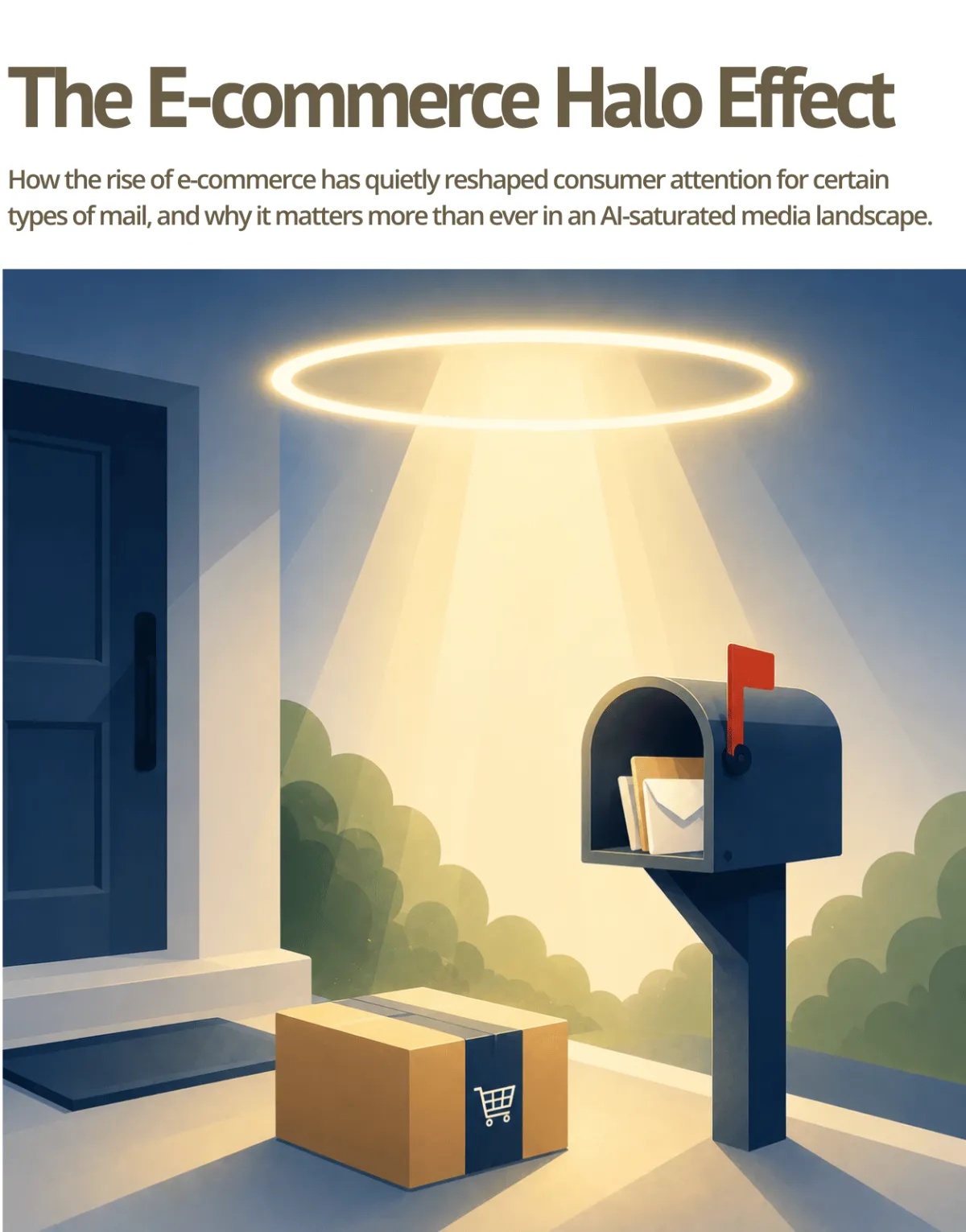
This report defines this behavior as The E-commerce Halo Effect.
PART 1: THE SHIFT
Driving Force: Growth and Scale of E-commerce
US Parcels + Projections (billions) 2000-20312

E-commerce has shifted from a convenience to a default behavior. What was once an occasional delivery is now a routine part of daily life. Households that once received packages sporadically now experience a steady — often daily — flow of deliveries, ranging from essentials like household goods and groceries to apparel, electronics, and subscriptions. This is not an incremental increase. It represents a fundamental change in how goods move from purchase to possession.
As a result, the doorstep and mailbox have become a primary point of interaction at home. Deliveries are no longer events — they are expectations. The rise of tracking apps, real-time notifications, and defined delivery windows has embedded this behavior into daily routines. Consumers check their phones for updates, anticipate arrival times, and build small but consistent habits around monitoring when and where packages will appear. The delivery moment has become part of the rhythm of the day.
The scale of this shift is already immense. By volume, the U.S. Postal Service handles more total deliveries than FedEx and UPS combined — making it the largest delivery network in the United States.2 An estimated 1 in 3 small parcel deliveries arrives in the mailbox — either directly via USPS or through last-mile handoffs.
In 2024 alone, more than 22 billion packages were delivered in the U.S. — that’s over 60 million per day. What makes this transformation more significant is not just the current volume, but the trajectory. Parcel delivery in the U.S. is expected to exceed 30 billion packages per year by 2031.2
This growth signals that the conditions shaping consumer behavior today are not temporary — they are accelerating. As delivery frequency increases, so does the repetition of the behaviors that surround it: tracking, anticipating, checking, and monitoring. The result is a reinforcing cycle. More packages lead to more anticipation. More anticipation influences where consumers direct their attention.
Over time, this compounds. The physical delivery areas of the home — the doorstep and the mailbox — become consistent points of focus. The E-commerce Halo Effect does not emerge in a static environment. It is being strengthened, day by day, by the rapid expansion of the e-commerce fulfillment and package delivery network.
Confirmed: Consumers Paying More Attention to Mail
Since peaking in 2006, total U.S. mail volume has fallen by 49%, driven by the rise of digital communication.9 And yet, attention to mail is increasing.
Consumers report paying more attention to their mail, engaging with it more frequently, and monitoring it more closely in connection with expected deliveries (See Figures 1- 3).1
This pattern is not limited to a specific age group.
It holds across all age demographics, indicating that increased attention to mail is broadly distributed — not just a behavior of older consumers.
This change is observable across multiple dimensions of behavior — attention, anticipation, and engagement — as shown by the survey results below.
(Fig.1) “When you think about the number of packages that get delivered to your home now compared to 20 years ago, do you find yourself paying more attention to your mail to ensure that you don't miss any package deliveries?” 1

US Adults 25+ (US Adults 35+ / Top 2, 77%; Same, 21%; Bottom 2, 2%)
(Fig.2) “I pay close attention to my mail because I am always on the lookout for packages and deliveries.” 1

US Adults 18+
(Fig. 3) “I pay more attention to mail deliveries or packages which I expect based on recent purchases.” 1

US Adults 18+
Defined: The E-commerce Halo Effect
The E-commerce Halo Effect occurs when the anticipation of a delivery concentrates consumer attention at the home’s points of arrival — such as the mailbox or doorstep — thereby increasing the likelihood that other items in that same physical space will receive incidental attention.
What’s Happening
E-commerce has changed more than how products are purchased. It has changed where and when attention is focused. When a consumer is expecting a delivery, their behavior shifts:
They monitor for updates
They check the mailbox or doorstep more frequently
They become more alert to anything within the arrival zone
This is not passive awareness. It is directed attention driven by anticipation. And once attention is activated, it rarely remains isolated to a single object.
PART 2: THE MECHANISM
Monitoring Becomes a Habitual Behavior
The survey data indicates a measurable increase in consumer attention toward mail. The critical question is what underlying mechanisms are driving this shift.
While the growth of package delivery explains increased exposure, exposure alone does not account for the persistence and consistency of the observed behaviors. To understand this change, it is necessary to examine the psychological processes that govern repeated behavior.
What’s emerging is not simply an increase in attention, but the formation of a habit.
“For most of the modern era, checking the mail carried a quiet undercurrent of stress, mainly from bills. Neurochemically, that’s the fight-or-flight response: adrenaline, vigilance, the body bracing for bad. But two things changed.
First, bills migrated to screens. Second, packages became top of mind, triggering dopamine and serotonin, the chemicals of anticipation and reward. The stressor left the mailbox, and a reward moved into the delivery area. And once the brain associates a physical space with reward, it tends to bring a more receptive attention to whatever else turns up there, including certain types of mail.”
— Dr. George S. Everly, Jr.
A habit is a learned behavior that becomes automatic through repeated exposure to a cue and reinforcement by a reward. In Atomic Habits, James Clear describes this process as a four-step sequence:
Cue → Craving → Response → Reward
In the context of home delivery:
Cue: Purchase confirmations, shipping notifications, and delivery windows
Craving: Anticipation of the package's arrival
Response: Tracking updates, checking devices, and monitoring delivery locations
Reward: Receipt of the package
Each completed delivery reinforces the cycle. As deliveries become more frequent, consumers experience more cues, more anticipation, and more opportunities to repeat the behavior. Over time, monitoring the mailbox and doorstep becomes increasingly automatic.
This shift has important implications. First, attention becomes habitual rather than deliberate. Second, consumers become more responsive to related signals within the same environment. Third, the behavior persists and strengthens over time as new deliveries continue to trigger the cycle. The result is a sustained pattern of attention focused on the physical delivery points of the home.
Example: USPS ‘Informed Delivery’ Increases Mail Engagement
A similar pattern can be observed in digital mail preview systems such as USPS Informed Delivery.
This service provides users with a daily email containing images of incoming mail, effectively introducing a digital anticipation layer before physical delivery.
Adoption has been substantial, with more than 70 million users and a majority reporting that it has become part of their regular routine. Importantly, this behavior has measurable effects: users of Informed Delivery spend significantly more time engaging with their mail compared to non-users, with studies indicating increases of up to 39% when digital preview and physical interaction are combined. 10
This represents a critical extension of the behavioral loop. Anticipation is no longer triggered solely by physical cues, but also by digital signals that precede them. As a result, attention to certain types of mail begins earlier, lasts longer, and becomes more consistent.
Attention Checkpoints: Doorstep and Mailbox
The behaviors described previously are anchored to a specific physical environment: the point at which deliveries arrive.
The mailbox and doorstep represent a threshold between the external world and the home. Unlike digital environments that compete for attention, this threshold is characterized by relatively low informational noise. It is not saturated with competing messages, interfaces, or stimuli. Instead, it is a controlled and familiar space, where even small changes are easily detected and interpreted.
As delivery frequency increases, this location becomes associated with anticipated outcomes. Consumers repeatedly return to it, physically or visually, as part of their daily routines. What begins as a response to a specific delivery evolves into a pattern of ongoing monitoring.
Because the cost of checking is low and the potential reward is immediate, this behavior is reinforced quickly. Over time, the mailbox and doorstep become consistent points of focus — locations where attention is not only directed, but expected.
The influence of e-commerce on consumer attention can also be seen in the growth of the $3 billion smart doorbell and doorstep-monitoring market. 11 As consumers place greater importance on tracking deliveries, many have adopted tools that extend visibility into the home's delivery space. These technologies expand the attention checkpoint beyond the physical act of checking the mailbox or doorstep, allowing consumers to monitor those spaces continuously throughout the day.
In this context, the household threshold functions as an attention checkpoint: a predictable, low-noise environment where anticipation concentrates attention and repeated interaction reinforces it.
The implications extend far beyond consumer behavior, reshaping how marketers should think about where attention is earned in an increasingly AI-saturated media landscape.
PART 3: THE OPPORTUNITY
The New Whitespace
AI now amplifies the production of low-cost content and messaging on digital channels. As this volume increases, consumer attention fragments. More messages compete for the same finite attention, making digital environments increasingly saturated and difficult to break through.
The doorstep and mailbox operate differently. They are constrained, low-noise environments with fewer competing stimuli and more focused attention. This creates a widening attention gap: one environment defined by infinite digital noise, the other by concentrated attention.
Winterberry Group describes a similar shift in its 2026 report (Delivering Performance in the Era of AI) and notes, "As AI disrupts their ability to attract and engage digital audiences, brands are vesting renewed importance in high-impact, real-world content and experiences."8
As digital saturation accelerates, low-noise environments become more valuable. The home’s delivery area evolves into a form of “attention whitespace” — a place where attention is not continually divided, but naturally focused.
Value of the Physical
Winterberry Group also observed, "tangible channels, such as direct mail, out-of-home and other physical channels, are going to become more important with the rise of AI because they are harder to fake and convey a greater sense of inherent trust."8
While AI increases the volume and noise of digital environments, it also creates a second effect: it makes physical media more distinct.
A piece of mail exists in the real world. It enters the home and must be physically handled, held, sorted, and experienced in a way digital media cannot. As consumers become inundated by synthetic and endlessly generated content, physical media gains additional significance simply because it is real.
In this new era, the tangible becomes more scarce — making the home’s delivery space more valuable because it offers a quieter environment where consumers can still engage with something physical.
Attention Expands for Deliveries
The effects of delivery-driven behaviors are not confined to the expected package itself. As anticipation and monitoring behaviors increase, attention begins to extend beyond the primary object of interest.
This is a well-documented pattern in behavioral science: when individuals actively monitor an environment for a specific signal, their sensitivity to adjacent stimuli increases. In this context, the repeated act of checking for deliveries leads to broader scanning behavior within the same physical space.
Once activated, attention does not remain narrowly focused. It widens.
As consumers monitor the mailbox or doorstep for expected deliveries, they simultaneously become more likely to notice other items within that environment — whether anticipated or not. This includes mail, packages, and other physical touchpoints located at the home’s delivery area.
This dynamic can be understood as an adjacency effect, where attention directed toward one stimulus increases the likelihood of engagement with nearby stimuli. Over time, repeated monitoring reinforces this expanded field of awareness, making incidental attention more frequent and more consistent.
The Halo Mechanism
Habit helps explain why consumers repeatedly monitor the mailbox and doorstep. But habit alone does not fully explain the persistence of that attention. The other factor at work is uncertainty.
“What sustains this kind of attention usually isn’t habit alone. It’s paired with uncertainty. Psychologists call it variable ratio reinforcement: rewards that arrive unpredictably tend to drive more persistent behavior than rewards we can predict,” explains Dr. Everly.
Attention behaves like a spotlight. When it is directed toward one expected item — a package — it expands to include adjacent stimuli within the same environment.
In this case, a consumer approaches the mailbox expecting a package. While there, they also notice certain types of mail that mimic the traits of the packages they are on the lookout for. These items benefit from the same moment of heightened attention.
But they are not paying closer attention to all mail equally. The increased attention is centered on mail that mimics the traits of their anticipated package and piques consumers’ curiosity about what’s inside.
Dr. Everly continues, “I saw it firsthand consulting for casino operators. It’s a large part of why a slot machine is so hard to walk away from. You don’t know what the next pull brings, so you keep going. Certain types of mail seem to follow the same logic. The attention concentrates on what echoes the package, the mail that makes you wonder what’s inside is less likely to be tossed unexamined because you can’t be sure you won’t miss something. Curiosity paired with consequence is a surprisingly reliable driver of behavior.”
The “halo” is significant because it doesn’t create attention, but shares a heightened state of attention that is already present.
The result is a measurable increase in visibility and engagement for items that exist within this delivery-focused environment.
This Behavior Is Not New
The expansion of attention beyond its original target has been documented before, most clearly on mobile devices.
Research by Mengqi Liao and S. Shyam Sundar found that smartphone notifications are associated with more frequent device pickups and increased screen time.4 A notification may begin as a prompt to check a specific message, update, or reminder, but it often leads to broader engagement behaviors beyond the original alert.
Researchers have described these sequences as pinball-like interactions, where attention moves from one cue to another, extending engagement across the surrounding environment.4,5 What begins as a single notification can trigger a broader pattern of checking, exploration, and monitoring.3
The E-commerce Halo Effect follows a similar pattern in the physical world.
A purchase confirmation, shipping update, or "out for delivery" alert begins with a specific purpose: tracking the arrival of a package. But the attention it creates often extends beyond the package itself. Consumers return repeatedly to the mailbox, doorstep, or entryway, increasing their awareness of other items and messages that occupy the same space.
In both cases, a cue initiates attention, attention expands beyond its original target, and adjacent stimuli benefit from the increased focus. The mechanism is not new. What is new is the environment in which it is occurring.
Conclusion
The E-commerce Halo Effect highlights a broader truth about how attention works: it is not only shaped by messages, but by behavior. As e-commerce continues to scale, it is quietly redefining where and when attention occurs within the home. The doorstep and mailbox are no longer passive endpoints for delivery — they are active checkpoints in a routine of anticipation, monitoring, and engagement. What begins as a simple act of checking for a package evolves into a repeated pattern of behavior, raising the baseline level of attention in that environment.
This shifting attention carries meaningful implications. Digital attention environments are defined by abundance and competition, but the doorstep and mailbox operate differently. They are comparatively low-noise environments, often containing only a small number of objects competing for attention during any interaction.
In a world where AI can generate infinite content but cannot manufacture the physical, the tangible has acquired new significance. A piece of mail is real. It occupies space. It must be picked up, held, and decided upon. No algorithm can replicate that moment — and no amount of digital volume can crowd it out. As AI continues to flood every screen with synthetic content, the contrast between what is generated and what is genuine will only deepen, making the physical environment of the home's delivery space not just low-noise, but irreplaceable.
This creates a fundamentally different attention posture: consumers are not just scrolling past digital stimuli; they are actively searching within a focused physical space shaped by anticipation and habit.
As delivery volume continues to grow and anticipation-driven behaviors become more deeply embedded, the importance of this attention environment is expected to increase. The E-commerce Halo Effect is not a temporary trend — it is the result of a structural shift in consumer behavior. Understanding and aligning with this shift offers a new lens for thinking about attention, one grounded not in interruption, but in the natural patterns of how people live, expect, and engage within their everyday environments.
What makes this behavior durable is that it is reinforced by physical rewards.
“AI can generate content at an infinite scale, but it can’t manufacture the neurochemical state that accompanies a real, physical reward. The home’s delivery space, conditioned by years of package anticipation, tends to be approached with a kind of dopamine-driven readiness, an openness to discovery that’s hard to reproduce through a screen,” says Dr. Everly.
“That isn’t a marketing claim. It’s brain science.”
Winterberry Group has similarly argued that physical channels will become more valuable as AI adoption grows because they are harder to fake and convey a greater sense of trust.
The central finding of this report is clear: e-commerce is increasing attention at the mailbox and doorstep. As delivery volume continues to grow, so will the habits that drive consumers to monitor these spaces. And as AI floods digital channels with content, the value of that attention for consumers and marketers is likely to grow in the years to come.
Methodology
The Effect of Package Delivery on Attention to Mail (2025) — National online survey of 1,800 U.S. adults, fielded via PureSpectrum using Alchemer from December 2024 through January 2025. Methodology independently reviewed by Decision Analyst.

Panel size: n = 1,800
Completion rate: 91% of respondents who began the survey
Survey field dates: 12/11/24 - 1/10/25
Margin of error: ± 2.2%
Confidence level: 95%
About the Report
The E-commerce Halo Effect report was produced by Jim Thompson, founder of Bright Trail Customer Development, a firm that helps small and mid-sized businesses better understand, reach, and build trust with prospective customers.
As part of that work, Bright Trail conducts independent consumer research projects to identify emerging behavioral shifts and communication patterns that impact how businesses connect with their audiences. This report was developed as part of that ongoing research effort focused on consumer attention, media environments, and evolving engagement behaviors.
This report was commissioned by Valpak Clipp and produced by Bright Trail Customer Development. The report's analysis, conclusions, and editorial content were developed independently by Bright Trail based on survey findings, supporting research, and subject matter expert interviews.
References
Following publication of this report, George S. Everly Jr., PhD, examined the E-commerce Halo Effect through the science of stress, conditioning, anticipation and reward. His article in the CSHR International Journal concludes that the findings warrant further analysis and explores the brain chemistry that may help explain the effect.
Read: “The Halo Effect: Visits to the Mailbox Were Once Associated With Stress—Times Have Changed,” published in CSHR, Vol. 8, No. 1, September 2026. Also shared in full in the Appendix.
Winterberry Group is a growth consultancy specializing in the intersecting disciplines of marketing, advertising, technology, data and analytics. They collaborate with stakeholders across those ecosystems—agencies, service providers, technology developers, publishers, marketer brands and investor groups—to identify and activate growth opportunities that drive the creation of real and lasting stakeholder value.
Dr. George S. Everly, Jr. is an internationally recognized psychologist and public health scholar who has studied the brain and human behavior for over 40 years. He is the author of more than 20 books and over 100 scientific papers, and from 2015 to 2025 was ranked the number one published author in his field.
1 The Effect of Package Delivery on Attention to Mail (2025)
2 Pitney Bowes US Parcel Shipping Index 2016-2031 (2015 and prior are estimated)
3 Beyond the Buzz: Investigating the Effects of a Notification-Disabling Intervention on Smartphone Behavior and Digital Well-Being. Dekker, Cynthia A.; Baumgartner, Susanne E.; Sumter, Sindy R.; Ohme, Jakob, 2025
4 Sound of silence: Does Muting Notifications Reduce Phone Use? Mengqi Liao, S. Shyam Sundar, 2022
5 Bayer & LaRose, Technology Habits: Progress, Problems, and Prospects
Joseph B. Bayer, Robert LaRose, 2018
6 Connection Cues: Activating the Norms and Habits of Social Connectedness, Joseph B. Bayer, Scott W. Campbell, & Rich Ling, 2016
7 Atomic Habits, James Clear, 2018
8 Winterberry Group. Delivering Performance in the Era of AI: Technology, Data, and New Opportunities to Unlock Omnichannel Success, 2026.
9 Postal Regulatory Commission Report — USPS Periodic Report 1970-2025
10 USPS Informed Delivery Year in Review 2024-2025
11 Grandview Research Smart Doorbell Market (2023 - 2030)
Appendix
The Halo Effect
Visits to the Mailbox Were Once Associated with Stress - Times Have Changed
George S. Everly, Jr., PhD
Originally published as an opinion article in CSHR International Journal, Vol. 8, No. 1, September 2026
This addendum reproduces Dr. Everly's article examining the behavioral and neurochemical mechanisms that may help explain the E-commerce Halo Effect.
Abstract The stress in most people's lives comes not from exposure to repeated traumatic events, but rather from everyday insidious trials and tribulations. Vigilantly scanning the environment for and avoiding potential sources of distress can be an effective stress management tool in the short run, but it neglects the potential that many stressors possess for reinterpretation. The story of the mailbox, changing from a potential source of dread to one of eager anticipation, is a story worthy of examination and serves as a fascinating metaphor, if not a valuable lesson, for life.
Keywords traumatic stress, stress, cumulative stress
The study of traumatic stress has largely dominated inquiry into the nature and treatment of human stress since its formal recognition in 1980. In doing so, it has overshadowed the study of another far more prevalent form of human stress that can be debilitating if not pathogenic - cumulative stress. Cumulative stress, sometimes referred to as burnout, arises from repeated exposures to non-traumatic stressors (Everly & Lating, 2019).
A key process in managing cumulative stress is recognizing the stressors themselves. Thus, surveillance of one's environment for potential stressors becomes a useful stress-management tactic. As we survey our environments for the obvious and not-so-obvious causes of stress, the story of the mailbox may offer a valuable lesson and even serve as a metaphor. The story of the mailbox is one of change, and this paper is the quest to understand its metamorphosis. The mailbox would likely be last on our list of usual suspects for stressors. The mailbox seems like such an innocuous aspect of everyday life for most people. Yet nothing could be further from the truth. Throughout history, the mailbox, or its equivalent, has engendered a virtual rollercoaster of emotional reactions. Now, not only has it become one less stressor, but it may be returning to its position as a once-vaunted repository of great expectations - a fact perhaps lost to history.
The Rise of the Mail-Order Industry
Let's begin with the good times. In 1872, Aaron Montgomery Ward mailed a single sheet of paper to potential buyers advertising products for purchase. It quickly evolved into the first general-merchandise mail-order catalog in American history.
Mail-order advertisements and larger catalogs changed consumer behavior forever. They didn't just change how people bought things - they changed how people thought about buying things. They rewired consumer behavior, creating habitual patterns of purchasing goods and services; in doing so, we may infer that they rewired consumers' brains (Mark et al., 2019). No doubt it was with great expectations that people went to their mailboxes to see how the world was changing through the latest products offered for sale. In fact, those great wishful expectations became codified in the Sears Wishbook catalog, which contained many of the things we likely wished to possess.
The Rise of E-Commerce
Mail-order advertisements and larger catalogs peaked in the 1950s and 60s. With the rise of suburban living, especially suburban shopping malls, and the increased availability of the family car, mail-order sales began to decline. Things began to change dramatically again in 1984, when CompuServe launched the first consumer-facing electronic mall. But it was not until 1995 that Amazon initiated the great quantum leap into e-commerce. The consumer's great expectations and the aspirations contained within the Wishbook were no longer fueled by trips to the mailbox or even the shopping center; rather, those needs would now be satisfied by images appearing on computer screens.
Stress and the Mailbox
As mail-order shopping opportunities declined, the mailbox was often relegated to a repository for incoming bills and the stress associated with them. Its once-positive valence as a conduit for great expectations shifted to a negative valence as a place to be approached with fear, or even avoided. More specifically, checking the mail now carried a quiet undercurrent of stress, mainly because of its association with stress-related bills and even overdue notices it might contain, while overlooking the potential for unexpected, more serendipitous revelations and opportunities. Mailbox anxiety was, and remains, a phenomenon seldom discussed. A 2026 post appearing on Urban Money Budgets says it rather well:
“Let's get something straight: money mail anxiety is real. Not cute. Not quirky. No - this is full-body dread...This is heart-pounding, gut-twisting, soul-shrinking fear, stuffed in an envelope and stamped with your name on it. It's a private kind of panic... You walk to the mailbox and immediately feel your chest tighten. You see a letter from your bank, and it's like your heart forgets how to beat normally ... It's your nervous system going into lockdown because your survival instincts are screaming, ‘Danger ahead. Protect yourself.’”
Neurochemically, we can infer that going to the mailbox in scenarios such as this had become associated with the fight-or-flight response: adrenaline, vigilance, the body bracing for bad (Everly & Lating, 2019). And so it was, until e-commerce expanded and became a virtual everyday occurrence.
Coming Full Circle
Then two things changed. First, bills slowly but surely left the mailbox, now largely sent by electronic media, migrating to computer screens; and second, prized packages containing highly desired commodities took their place in or near the mailbox. The stress response became less associated with the mailbox as the fear declined, and the biochemistry of anticipation and reward moved in, associated with the delivery of packages, which are desired rather than feared. Through a process known as conditioning, once the brain associates a physical space with reward, it tends to bring a more receptive attention to whatever else turns up there, including certain types of mail. Great expectations can once again abound. And this may translate into real changes in behavior.
The Halo Effect
Is this mere theory and speculation, or is there some evidence supporting this scenario? I was asked to review and comment upon a new report commissioned by Valpak Clipp and produced by Bright Trail Customer Development, entitled The E-commerce Halo Effect (Bright Trail, 2026). The report asserts that the mailbox and the doorstep are being rediscovered as prized places where dreams can still come true. More specifically, and consistent with our new expectations, the report states, perhaps counterintuitively, that e-commerce is actually increasing attention at the mailbox and the doorstep. In doing so, e-commerce, once seen as a competitor, may actually be creating new opportunities for mail-based advertising and sales. In doing so, it may be creating a renaissance for mail-based advertising. The report found that four out of five consumers are paying closer attention to their mail deliveries because they are always on the lookout for their packages. The report calls this the E-commerce Halo Effect. The Halo Effect was described by E. L. Thorndike (1920) and refers to the tendency for a positive appraisal to generalize beyond the original experience to things associated with the original source. So, the positive expectation and appraisal associated with packages now generalize even to the mail in close physical proximity.
Dopamine at the Doorstep
In my opinion, the findings of the aforementioned report warrant further analysis beyond a brief comment, as we may gain insight into the changing nature of stressors and their antitheses. The findings beg the question: what mechanisms might explain the reported effect? Neuroscience has revealed that the brain chemistry of anticipation and reward involves dopamine and serotonin (Iigaya et al., 2020). We may speculate that early mail-based advertisements and catalogs were associated with acute surges in these uplifting chemicals. The repeated elicitation of these responses then led to the creation of a habit through a combination of variable-interval operant and classical conditioning. The rise of in-person shopping and, later, e-commerce diminished the appeal of mail-order products. And let us not forget mail anxiety cited earlier. But now, it appears the mailbox and the doorstep have become the beneficiaries of e-commerce. It's not just marketing; it's likely brain chemistry that reduces the stress once associated with the mailbox and replaces it with potentially uplifting experiences.
In sum, the stress left the mailbox, and reward has moved in. Early psychologists have taught us that once the brain associates a place with reward, it naturally pays more attention to whatever else appears there. It seems the mailbox and doorstep have become places where the brain increasingly expects reward. Thus, as we scan the horizon for potential sources of stress in our lives, let's keep in mind the story of the mailbox and its potential for change - that is, to be reinterpreted. Though perhaps not on the scale of the Phoenix, the mailbox has morphed from a potential source of stress to a potential source of rewards. In doing so, the mailbox can serve as a metaphor reminding us that other stressors have the same potential for reinterpretation. And in the process, perhaps it gives us all something else to look forward to.
References
Bright Trail (2026). The E-commerce Halo Effect.
https://brighttrail.biz/post/e-commerce-halo-effect-2026
Everly, G. S., Jr. & Lating, J. M. (2019). Clinical guide to the treatment of the human stress response. Springer.
Iigaya, K., Hauser, T. U., Kurth-Nelson, Z., O'Doherty, J. P., Dayan, P., & Dolan, R. J. (2020). The value of what's to come: Neural mechanisms coupling prediction error and the utility of anticipation. Science Advances, 6(25), eaba3828.
https://doi.org/10.1126/sciadv.aba3828
Mark, T., Bulla, J., Niraj, R., Bulla, I., & Schwarzwäller, W. (2019). Catalogue as a tool for reinforcing habits: Empirical evidence from a multichannel retailer. International Journal of Research in Marketing, 36(4), 528-541.
https://doi.org/10.1016/j.ijresmar.2019.01.009
Thorndike, E. L. (1920). A constant error in psychological ratings. Journal of Applied Psychology, 4(1), 25-29.
https://doi.org/10.1037/h0071663
Urban Money Budgets. (2026). Stop ghosting your bills: Confronting Money Mail Anxiety.
https://urbanmoneybudgets.com/stop-ghosting-your-bills-confronting-the-mail-that-haunts-your-inbox/